Introduction
Pigs have a poor utilization of phytate-bound P derived from plant feed ingredients and supplemental phytase is, therefore, often used in pig diets (Selle and Ravindran, 2008), which is a very effective way to increase P digestibility. However, digestibility of Ca is also increased by phytase (Lee et al., 2023).
Bestzyme has recently been developed as a novel phytase, but there is limited information on how this phytase works on P and Ca digestibility. Therefore, the objective of this experiment was to test the hypothesis that a novel microbial phytase can replace some of the dietary P and Ca in diets for growing pigs without negatively impacting the standardized total tract digestibility (STTD) of P and Ca.
Materials and methods
A total of 8 diets were prepared based on corn and soybean meal. Three diets contained 3 different levels of P and Ca. The positive control diet contained dicalcium phosphate and limestone to meet requirements for Ca and P for 11 to 25 kg pigs (NRC, 2012). Therefore, this diet contained 0.33% standardized total tract digestible P and 0.70% Ca. Concentrations of Ca and P were reduced from the PC to formulate the intermediate control and this diet contained 0.25% standardized total tract digestible P and 0.54% Ca. However, the negative control diet contained only 0.18% standardized total tract digestible P and 0.38% Ca. Therefore, the IC and NC diets were deficient in Ca and P.
Five additional diets were formulated by adding 500, 1,000, or 2,000 unit/kg diet of the microbial phytase Bestzyme (BestaAg, Houston, USA) or by adding 1,000 unit/kg diet of Quantum Blue phytase (AB Vista, Marlborough, UK) or HiPhorius phytase (dsm-firmenich, Maastricht, NL) to the negative control diet.
A total of 64 pigs (initial body weight = 12.16 ± 1.12 kg) were allotted to 8 diets using a randomized complete block design with 32 pigs per block and 4 replicate pigs per diet in each block. Therefore, there were a total of 8 replicate pigs per treatment in the two blocks. Pig weaning group was the block. Pigs were housed individually in metabolism crates that were equipped with a self-feeder, a nipple waterer, and slatted floors to allow for the total collection of feces. The initial 5 days were considered the adaptation period to the diet, whereas fecal materials were collected from the feed provided during the following 4 days according to standard procedures using the marker-to-marker approach (Adeola, 2001). The apparent total tract digestibility (ATTD) of DM, Ca, and P in experimental diets was calculated (Almeida and Stein, 2010). The STTD of P and Ca in each experimental diet was calculated by correcting the ATTD of P and Ca for the average basal endogenous loss of P (i.e., 190 mg/kg DM intake; NRC, 2012) and Ca (i.e., 471 mg/kg DM intake; Lee at al., 2023).
The standardized total tract digestible P was calculated by multiplying P in diets by the STTD of P and dividing the value by 100. The released standardized total tract digestible P was then calculated by subtracting digestible P of the NC diet from digestible P of the diets containing phytase. The released standardized total tract digestible Ca was calculated using the same method as for P.
Results
There were no effects of reducing Ca and P levels from the positive control to the intermediate control or the negative control diet for feed intake, dried fecal weight, the ATTD of DM, or basal endogenous loss of P (Table 1). Phosphorus intake, P absorption, and the ATTD and the STTD of P were reduced (linear; P < 0.05) as dietary Ca and P levels were reduced. In contrast, P in feces and fecal P output increased (linear; P < 0.05) with decreasing levels of Ca and P. There were no effects of increasing Bestzyme in diets for feed intake, dried fecal weight, the ATTD of dry matter, or basal endogenous loss of P, but P intake increased (linear; P < 0.05) as Bestzyme increased in diets containing low Ca and P. Phosphorus in feces and fecal P output were reduced (quadratic; P < 0.05) by increasing Bestzyme to 2,000 units/kg. Therefore, P absorption and the ATTD and STTD of P increased (quadratic; P < 0.05) with increasing Bestzyme in the low Ca and P diets. There were no differences in the ATTD of DM, the ATTD of P or the STTD of P between diets containing 1,000 units of Bestzyme and 1,000 units of Quantum blue. However, dried fecal weight of pigs fed diets containing 1,000 units of Bestzyme tended to be greater (P < 0.10) compared with pigs fed 1,000 units/kg of HiPhorius. The ATTD of DM in the diet containing 1,000 units of Bestzyme was less (P < 0.05) than the diet containing 1,000 units of HiPhorius. The concentration of P in feces from pigs fed the diet containing Bestzyme tended to be reduced (P < 0.10) compared with feces from pigs fed HiPhorius. However, the STTD of P was not different between the diets containing 1,000 units of Bestzyme and 1,000 units of HiPhorius.
Calcium intake, Ca absorption, the ATTD of Ca, and the STTD of Ca were reduced (linear; P < 0.05) as dietary Ca and P were reduced from positive control to the intermediate control or the negative control diet (Table 2). Calcium intake of pigs and basal endogenous loss of Ca were not affected by increasing Bestzyme in diets. Calcium in feces and Ca output were reduced (quadratic; P < 0.05) by increasing Bestzyme to 2,000 units/kg. Therefore, Ca absorption, the ATTD of Ca, and the STTD of Ca increased (quadratic; P < 0.05) with increasing Bestzyme in diets. There were no differences in the ATTD of Ca or STTD of Ca between diets containing 1,000 units of Bestzyme, 1,000 units of Quantum blue or 1,000 units of HiPhorius.
Key points:
- Supplementation with the novel microbial phytase (Bestzyme) improved phosphorus and calcium utilization in diets deficient in Ca and P.
- At 1,000 units of Bestzyme phytase appears to be effective in releasing Ca and P from phytate in corn+soybean meal based diets fed to growing pigs
Table 1. Apparent total tract digestibility (ATTD) of dry matter (DM) and standardized total tract digestibility (STTD) of P in experimental diets fed to growing pigs1
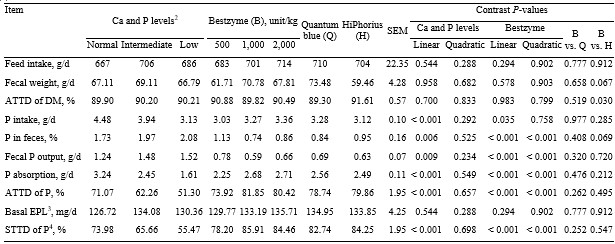
1Least mean squares represent 8 pens per each treatment, except for the diet containing normal Ca and P levels (n = 6), the diet containing intermediate Ca and P levels (n = 7), and the diet containing Quantum blue (n = 6).
2Diets containing normal, intermediate, and low Ca and P represent positive control, intermediate control, and negative control, respectively. Concentrations of Ca and P were low in the five diets containing phytase.
3EPL = endogenous P loss, this value was estimated to be 190 mg per kg of DM intake (NRC, 2012). The daily basal EPL (mg/d) for each diet was calculated by multiplying the EPL (mg per kg of the DM intake) by the daily DM intake of each diet.
4Values for STTD were calculated by correcting values for ATTD for basal endogenous losses (NRC, 2012).
Table 2. Apparent total tract digestibility (ATTD) of Ca in experimental diets fed to growing pigs1
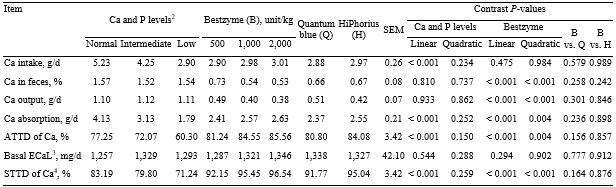
1Least mean squares represent 8 pens per each treatment, except for the diet containing intermediate Ca and P levels and the diet containing Quantum blue (n = 7).
2Diets containing normal, intermediate, and low Ca and P represent positive control, intermediate control, and negative control, respectively. Concentrations of Ca and P were low in the five diets containing phytase.
3ECaL = endogenous Ca loss, this value was estimated to be 471 mg per kg of dry matter (DM) intake (Lee et al., 2023). The daily basal ECaL (mg/d) for each diet was calculated by multiplying the ECaL (mg per kg of the DM intake) by the daily DM intake of each diet.
4Values for STTD were calculated by correcting values for ATTD for basal endogenous losses (NRC, 2012).