Calcium (Ca) is an essential macro mineral required for growth, bone development and remodeling, enzyme activity, cellular signaling, and metabolic regulation in swine (González-Vega and Stein, 2014). The concentration of Ca in diets and ingredients is a key feature because excess Ca decreases the digestibility of P and other nutrients and decreases feed intake and growth performance (Stein et al., 2011; Merriman et al., 2017; Lagos et al., 2019). Ideally, the requirement for Ca should be expressed as standardized total tract digestible (STTD) Ca instead of total Ca (NRC, 2012), which necessitates the generation of values for Ca digestibility in feed ingredients (Lautrou et al., 2020; Lee and Kong, 2022; Lee et al., 2023a). In plant feed ingredients, Ca concentration is low compared with inorganic sources; however, Ca in soybean meal (SBM) ranges from 0.25% to 0.75% (Sotak-Pepper et al., 2016; Lee et al., 2023a). Because SBM sometimes is included at high proportions in swine diets, Ca analysis of SBM is important to supplement diets with adequate quantities of additional Ca to meet requirements without including excess Ca in diets.
Phytase is an exogenous enzyme that catalyzes the hydrolysis of P from phytate, thereby increasing P digestibility and releasing other nutrients, including Ca, from the phytate matrix (Humer et al., 2014; Hu et al., 2022; Nelson et al., 2022). Supplementation with phytase can reduce the formation of insoluble Ca–phytate complexes, which may increase Ca digestibility in diets fed to pigs (Dersjant-Li and Dusel, 2019; Nelson et al., 2022). Because excess Ca has a negative impact on growth performance of pigs, it is important to account for the Ca released by phytase when formulating diets (Merriman et al., 2017; Lagos et al., 2019; Lee et al., 2023a). Phytase increases Ca digestibility and improves P digestibility (Almeida et al., 2013; Lee et al., 2023b), but data documenting the release of Ca from SBM by graded levels of microbial phytase are not available. Therefore, the objective of this experiment was to test the hypothesis that graded levels of microbial phytase gradually increase Ca digestibility in SBM regardless of SBM source.
Materials and methods
A total of 160 pigs (initial BW = 14.13 ± 2.4 kg) were used in a randomized complete block design with 20 diets and 8 replicate pigs per diet. Three diets were formulated based on corn and 1 of 3 sources of SBM, and 12 additional diets were formulated by supplementing each of these diet with 500, 1,000, 2,000, or 4,000 phytase units (FTU)/kg (Quantum Blue, AB Vista, Marlborough, UK). Because SBM does not provide all the Ca that is needed by pigs, calcium carbonate was also included in the SBM containing diets. To calculate the digestibility of Ca in calcium carbonate at each phytase level, 5 additional diets based on corn and potato protein concentrate were formulated with 0, 500, 1,000, 2,000, or 4,000 FTU/kg. Results from these diets allowed for calculation of the digestible Ca provided by calcium carbonate to the corn-SBM diets at each level of phytase and the digestibility of the Ca that originated from SBM was then calculated by difference. Pigs were fed experimental diets for 12 days, including 4 days of total fecal collection.
Results
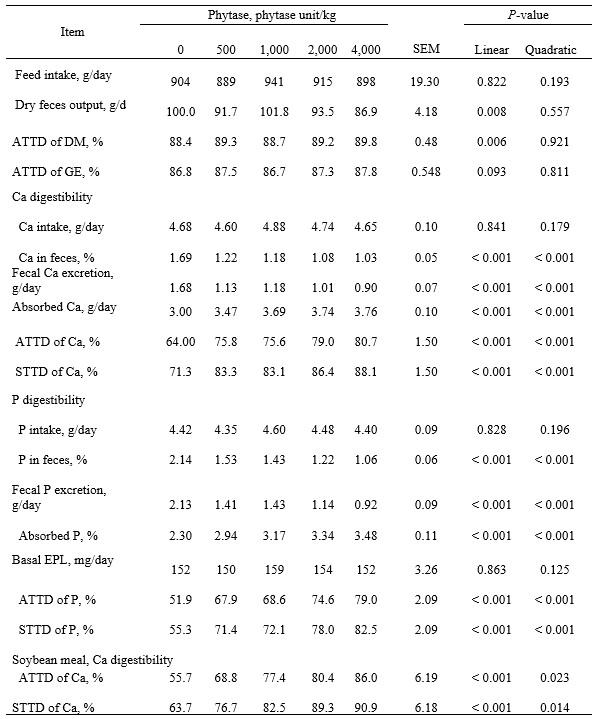
No interactions between SBM source and phytase were observed and there were no differences among the three sources of SBM. Therefore, only the main effects of phytase is reported. Increasing phytase reduced (linear, P < 0.01) fecal output and increased (linear, P < 0.01) ATTD of dry matter. Phytase did not affect Ca or P intake, but decreased (linear, P < 0.001) fecal Ca and P excretion and increased (quadratic, P < 0.01) absorbed Ca and P as well as ATTD and STTD of Ca and P. Both ATTD and STTD of Ca in SBM increased (quadratic, P ≤ 0.05) as phytase increased from 0 to 4,000 FTU/kg.
Conclusion
The hypothesis that ATTD and STTD of Ca in SBM increased as microbial phytase was included in diets was accepted and it is, therefore, important to use a greater value for ATTD and STTD of Ca in SBM if microbial phytase is also included in the diets.
Table 1. Apparent total tract digestibility (ATTD) and standardized digestibility (STTD) of Ca and P in diets containing graded levels of phytase and ATTD and STTD of Ca in each source of SBM1.
1Data are least squares means; n = 24.